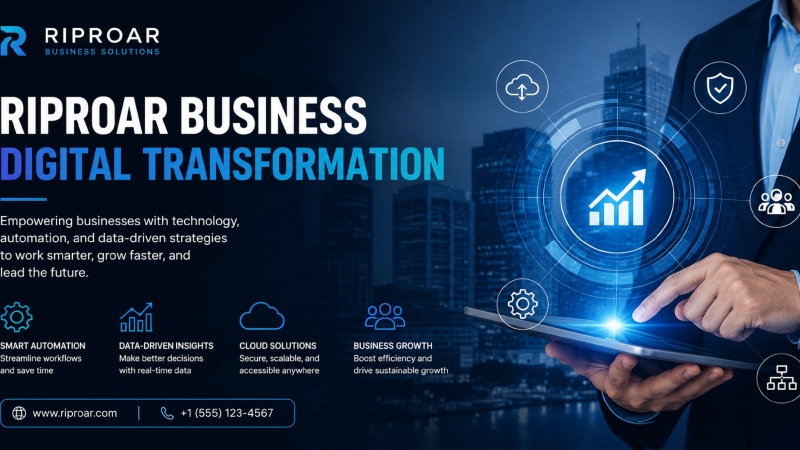
Every business eventually reaches a breaking point where old systems can’t keep up with new demands. As businesses grow, information often ends up scattered across multiple spreadsheets and platforms, while teams spend valuable hours on repetitive tasks that could easily be automated and completed in seconds. This is exactly the gap that Riproar business digital transformation is designed to close.
Rather than treating technology as an afterthought, Riproar business digital transformation puts digital tools at the center of how a company operates — connecting departments, automating routine work, and giving leaders the real-time visibility they need to make faster, smarter decisions.
This guide breaks down what digital transformation actually means, why it matters now more than ever, and how to approach it in a way that delivers real, measurable results.
What Is Riproar Business Digital Transformation?
At its core, Riproar business digital transformation is the process of rethinking how a business runs by weaving digital technology into every part of its operations — not just the IT department. That includes:
- Replacing manual, paper-based, or spreadsheet-driven processes with connected digital systems
- Automating repetitive tasks like invoicing, scheduling, and reporting
- Centralizing customer and operational data so it’s accessible in one place
- Redesigning workflows so teams collaborate more efficiently
- Building a culture that embraces continuous improvement rather than one-off fixes
It’s important to understand that this isn’t a single project with a finish line. It’s an ongoing evolution — businesses that succeed with digital transformation keep refining their systems as their needs and the market change.
Why Digital Transformation Matters More Than Ever
Customer expectations have shifted permanently. People expect fast responses, personalized service, and seamless experiences whether they’re interacting with a five-person startup or a global brand. Businesses that still rely on disconnected tools and manual processes struggle to keep pace.
A few forces are driving the urgency:
- Rising customer expectations — Slow response times and inconsistent service now cost businesses customers, not just convenience.
- Remote and hybrid work — Teams need cloud-based systems they can access from anywhere.
- Data overload — Businesses collect more information than ever, but without the right systems, that data goes to waste.
- Competitive pressure — Competitors who modernize faster win market share and operate at lower cost.
Core Pillars of a Successful Digital Transformation Strategy
Cloud Adoption
Moving core systems to the cloud is often the foundation of transformation. It supports remote collaboration, scales with business growth, and gives teams real-time access to shared information instead of siloed files.
Automation of Repetitive Work
Manual tasks like data entry, invoicing, and scheduling drain time and introduce errors. By automating repetitive tasks, businesses can save time, reduce costly errors, and allow employees to focus on more important and valuable work.
Centralized, Accessible Data
When customer and operational data is scattered across inboxes, spreadsheets, and individual employees’ heads, decision-making suffers. Bringing that information into one connected system gives leadership a clear, accurate picture of what’s actually happening in the business.
Smarter Customer Experience
Faster response times, more personalized communication, and consistent service across channels all stem from having the right systems in place. Better data and automation directly translate into stronger customer relationships.
A Culture Built for Change
Technology alone doesn’t drive transformation — people do. Successful organizations train their teams to adopt new tools, encourage experimentation, and treat improvement as an ongoing habit rather than a one-time initiative.
Common Challenges Businesses Face
Digital transformation isn’t without obstacles. Some of the most common hurdles include:
- Resistance to change among employees comfortable with existing processes
- Budget concerns, especially for small and mid-sized businesses wary of expensive enterprise overhauls
- Choosing the wrong tools that don’t fit the size or complexity of the business
- Lack of a clear strategy, leading companies to adopt new technology without a plan for how it supports business goals
The businesses that succeed are the ones that start with clear objectives — growth, efficiency, better customer retention — and then choose technology that directly supports those goals, rather than adopting tools for their own sake.
Practical Steps to Get Started
- Audit your current processes. Identify where time is being lost, where data is fragmented, and where customers experience friction.
- Set clear, measurable goals. Whether it’s cutting operational costs by a specific percentage or reducing response times, define what success looks like.
- Prioritize high-impact areas first. Start with the processes causing the most pain rather than trying to overhaul everything at once.
- Choose scalable tools. Select solutions that can grow alongside your business, so you can avoid replacing or rebuilding your systems as your needs expand.
- Train your team. Adoption fails when employees don’t understand or trust new systems — invest in onboarding and support.
- Measure and adjust. Track outcomes against your original goals and refine the approach as you go.
Who Benefits Most?
Digital transformation isn’t reserved for large enterprises. In fact, small and mid-sized businesses often see the fastest, most noticeable gains because they’re starting from a lower baseline of automation:
- Service-based businesses can manage clients, bookings, and communication more efficiently.
- E-commerce companies can track orders, inventory, and customer data in one connected system.
- Local businesses can strengthen their online presence and streamline customer communication.
- Growing companies can build the infrastructure needed to scale without losing control of operations.
Final Thoughts
Riproar business digital transformation isn’t about chasing the latest technology trend — it’s about aligning digital tools with real business goals to work smarter, serve customers better, and grow sustainably. Companies that approach it strategically, starting with clear objectives and prioritizing the areas that matter most, consistently see lower costs, higher productivity, and stronger customer relationships.
The businesses that thrive over the next decade won’t necessarily be the biggest — they’ll be the ones that adapt fastest. Starting that shift today puts your business ahead of competitors still relying on yesterday’s systems. Click here.